
You've got a job to do, a team to support, and only so much time left after the day's work is finished. The appeal of management courses online is obvious in that moment, because study has to fit around shifts, meetings, family life, and the practical need to keep earning while you improve. The harder question is not whether online learning is convenient, but whether the course will be recognised, whether it will teach something useful, and whether it will help you move forward.
Table of Contents
- Why Online Management Courses Matter for UK Professionals
- Types and Levels of Online Management Courses
- Self-Paced Versus Cohort-Based Delivery
- How to Evaluate Providers and Accreditation
- Curricula and Learning Outcomes Explained
- Employer Recognition and the UK Skills Market
- Career Pathways After Completing an Online Course
- Choosing the Right Programme for Your Goals
Why Online Management Courses Matter for UK Professionals
A manager's day is often built from small decisions, not grand speeches. One minute it is a rota gap, the next it is a disagreement between colleagues, and later it is a budget or deadline that needs attention. Online management courses matter because they help professionals make sense of those everyday responsibilities while keeping their jobs and routines in place. For many people, the question is not whether they can study, but whether the study will be recognised by employers and match the kind of work they already do.
That is where employer recognition becomes the true test. A course that looks neat on a webpage can still be weak if it does not explain what skill it develops, how it is assessed, or what a manager should do with the learning afterwards. Government Skills shows that public-sector learning has long used online delivery to build capability at scale, including courses for managers and aspiring managers, which underlines a simple point, online learning is now part of formal workforce development, not a casual extra Government Skills.
Coordinating people day to day is its own skill, and our overview of what team management involves shows how courses map onto it. A learner may already supervise staff informally, but still need a programme that turns instinct into repeatable practice, especially around communication, delegation, and prioritisation. That is why the design of the course matters as much as the title on the certificate.
For working professionals, fit is the practical filter. A course has to sit beside employment, family life, and the pressure of keeping work moving. Online routes now range from short CPD study to longer qualification pathways, so the task is choosing a programme whose delivery, accreditation, and curriculum line up with the outcome you want.
A classroom course can feel like a fixed train journey, one route and one timetable. Online study is more like a set of connections, some direct, some slower, each suited to a different working pattern.
Types and Levels of Online Management Courses
The online management field is best understood by separating format, level, and recognition. A short CPD certificate serves a different purpose from a longer award or diploma, and employers usually read the certificate through the lens of what it proves, not just how fast it was completed. That is why the first question should be, what kind of competence is this course designed to show?
Short CPD routes and longer qualification pathways
A CPD-accredited course is usually aimed at continuous professional development, so it is often modular, practical, and easier to fit around work. A regulated qualification is different, because it sits within a formal qualification framework rather than just recording professional development. In employer terms, CPD can be useful, but the strongest signal is still clear learning outcomes, assessment, and a certificate that can be checked quickly NCFE.
Longer online pathways can feel more like a structured study programme for professionals who want depth. The University of Essex, for example, delivers an online PG Cert in Business and Management, with an indicative duration of 8 months, and also an online MSc in Business and Management with an indicative duration of 2 years. The PG Cert includes a 20-credit Statistics for Business module focused on management decision-making and quantitative problem-solving, which shows how online management education can range from compact upskilling to extended progression routes University of Essex.
You can also see the market in between those two ends. Some providers structure learning around guided hours, access periods, and CPD points, which helps learners and employers judge the commitment involved. One UK provider states its course is 100% online, has four units, provides 100 guided learning hours, and gives access for two years learndirect.
A simple comparison
| Course Type | Typical Length | Level | Best For |
|---|---|---|---|
| CPD certificate | Short to modular | Professional development | Learners who need recognised upskilling beside work |
| Short postgraduate route | Months | Postgraduate | Professionals wanting academic depth with flexibility |
| Diploma-style pathway | Longer and structured | Applied management | People aiming for broader competence and stronger progression |
| Mini-MBA style study | Compact but intensive | Applied business | Learners wanting strategy, leadership, and general management exposure |
| Stackable course set | Modular over time | Mixed, depending on provider | Busy professionals building capability in stages |
A useful example is the Advanced Professional Certificate in Business Management, which sits in the sort of compact, structured pathway that works for people who want a clear study shape rather than a loose collection of topics.
Self-Paced Versus Cohort-Based Delivery
Self-paced and cohort-based study differ less in content than in who sets the rhythm, the student or the provider. That matters in management learning because a course only works if people can keep going long enough to finish it.
How the two models feel in practice
A self-paced course suits a calendar that changes from week to week. Recorded lectures, reading materials, and timed assessments let the learner fit study around work, family, or shift patterns, so progress can be steady rather than fixed to one evening each week. A fixed-office manager may use that flexibility to study after commuting and meetings, while a shift worker may need it just to keep learning alive.
Cohort-based programmes work differently. They begin on a shared date, set common milestones, and create accountability through tutors and peers. For some learners, that structure feels like a timetable with handrails. For others, it can feel pressurised if work is already unpredictable.
As a rule of thumb, choose self-paced study if your main risk is lack of time. Choose a cohort if your main risk is dropping the course when work becomes busy.
The better choice depends on habits as much as ability. A self-paced course asks for more self-management because no one is checking your weekly progress. A cohort course adds outside pressure, but that pressure can help a learner who works better with deadlines and group contact. In management study, the same person may do well in one format and struggle in the other, so the fit matters as much as the subject.
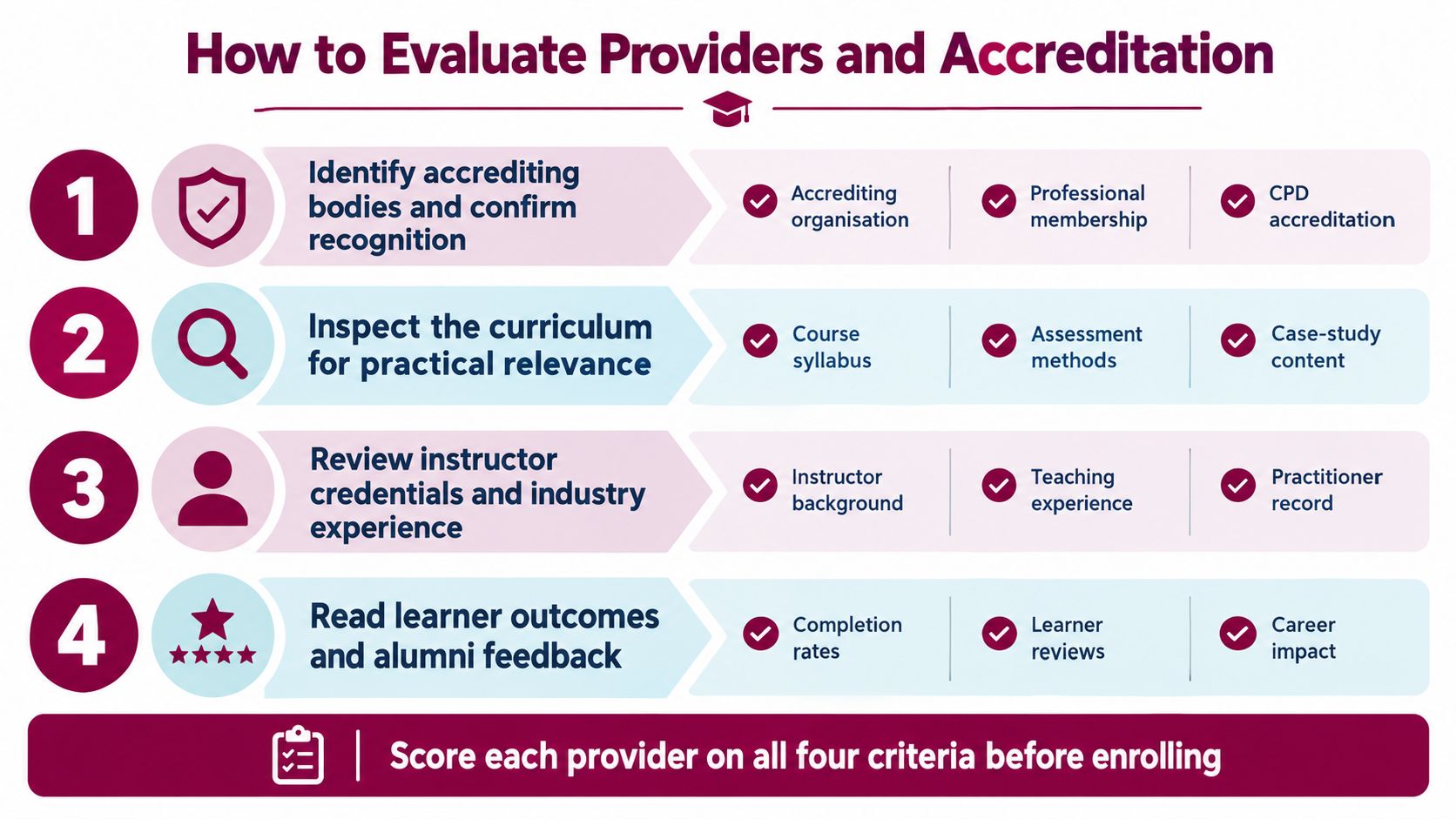
The evaluation should also include verification and provider design, not just the timetable. The infographic below shows the four most useful checks before enrolling.
How to Evaluate Providers and Accreditation
A course page can sound impressive and still leave a manager guessing. Start by asking what kind of recognition sits behind the certificate, how the learner is assessed, and whether an employer can verify the result without chasing extra paperwork. Employers tend to trust evidence, not decoration.
Step 1, identify the type of recognition
Check whether the course is CPD-accredited, whether it sits within a regulated qualification framework, or whether it is only a provider-issued certificate. That difference matters because CPD supports development, but it is not the same as a regulated award. As one accreditation body explains, asynchronous learning can count for CPD when it has stated outcomes and evidence of engagement with written, audio, or video materials, which shows that delivery mode alone does not decide value CPD Accredited.
Step 2, inspect how competence is assessed
A credible course should ask the learner to show understanding, not just attendance. That may mean a quiz, written assignment, practical task, or scenario-based work. If the only proof is that someone clicked through the material, employers may reasonably treat the certificate as lightweight.
Step 3, check how the certificate is verified
A trustworthy certificate should be traceable. A UK digital certificate verification system explains that e-certificates can be checked through a QR code or by entering the learner's name and authentication code into a verification portal, and that the document is valid only when viewed in the specified verification URL OTHM e-certificate verification. For a hiring manager, that works like checking a receipt against the original transaction. The record can be confirmed quickly, without relying on the learner's own explanation.
Step 4, look at the provider's clarity
Transparent course scope, accessible support, and clear certificate wording all matter. Where the provider also states the structure and learning outcomes, the signal is stronger. If a course promises a diploma but hides the curriculum, avoids assessment detail, or suggests shortcuts through prior learning without substance, treat that as a warning sign.
The same tests apply to dedicated leadership training courses, which show what a transparent provider page looks like in practice. The London School of Business Administration's online management offering fits into this discussion as a UK-based option with structured self-directed delivery, recorded materials, assessments, and certificate verification through an online check, which gives employers a clear way to confirm completion.
Curricula and Learning Outcomes Explained
A good management curriculum does not throw topics at the learner in random order. It builds a sequence of competence, so that each module gives you something you can use in the next one. That is why course design matters as much as course title.
A realistic learner journey
Take a mid-level professional who starts with strategic leadership. The first module might focus on how managers set direction, organise priorities, and decide what deserves attention. In plain terms, the learner is moving from “what do I need to do today?” to “what should this team be trying to achieve over the next quarter?”
The next module might cover marketing management. That may sound like a separate topic, but it becomes useful the moment a manager has to understand customers, positioning, and demand. A practical assignment here might ask the learner to review a service or product, identify the target audience, and explain how the offer should be presented more clearly.
A third module could focus on data-driven decision making. That is where spreadsheets, dashboards, and simple interpretation become part of management rather than a separate technical skill. If a learner can read a KPI dashboard, test an assumption, and explain what the numbers suggest, they have moved from opinion to evidence.
What the learning outcomes should connect to
A strong curriculum should tie each topic to workplace tasks. Team performance frameworks help a manager review how people are doing. Strategic planning tools help them decide where effort should go. Customer acquisition analysis helps them understand why growth is slowing. KPI dashboards help them explain performance in a meeting without guessing.
Good learning design turns abstract topics into usable habits. If the module cannot be translated into a staff meeting, a budget conversation, or a planning document, it is probably too theoretical for most working professionals.
Stacked short courses can create cumulative competence that feels more coherent than a single large leap. A learner may not need a full degree before they can improve how they lead, plan, and measure work. What they need is a path that lets them build skill in a sensible order, without pausing their career to do it.
Employer Recognition and the UK Skills Market
UK employers tend to judge online management training by proof, not by format. They want to see an audit trail, evidence that the learner can apply the material, and a clear fit between the course and the duties of the role. The recognition question is really about what the certificate shows, not how it was delivered.
What the labour market is signalling
The clearest signal is that employers already use online learning at scale. The UK Employer Skills Survey 2024 summary reports that 70% of employers that trained staff used online training or e-learning, while only 59% funded any training at all, and average spend per employee fell to £2,710 from £3,250 in 2022. That points to two practical realities. Online delivery is now routine, and cost still shapes how training is chosen.
The same source reports that SMEs continue to identify managerial skill gaps. In plain terms, employers still want training that fits internal budgets and is easy to justify. A certificate matters most when it is paired with clear evidence of what the learner can do.
| Candidate Signal | Employer Perception | Verification Method |
|---|---|---|
| CPD-accredited certificate | Useful for development and internal upskilling | Check the certificate wording and provider record |
| Structured assessment | Stronger evidence of competence than attendance alone | Review assignment or test format |
| Applied project | Shows the learner can use ideas at work | Ask for a brief summary or portfolio piece |
| Verifiable certificate | Makes checking faster for HR and hiring managers | Use the certificate code, QR, or register |
| Course aligned to role goals | Suggests seriousness and planning | Compare the syllabus with the job target |
A short accredited course and a degree answer different employer questions. A degree signals a broader academic path, while a short course signals focused development in a specific area. Both can help, but the value changes with the role. A promotion case is often stronger when the learner can show a verified certificate, a clear project, and a trail of assessment rather than a title alone.
Career Pathways After Completing an Online Course
Online management courses work best when they point toward a real work outcome. A course is not a destination by itself, it is a tool for changing what you can credibly apply for, contribute to, or lead.
Three realistic routes
An early-career coordinator may use a short management certificate to move into a team-lead role. In that case, the course needs to cover scheduling, delegation, communication, and simple decision-making. The evidence that matters is usually a certificate, a completed project, and examples of how the learner handled responsibility in practice.
A mid-level supervisor may take a broader route towards regional operations management. That path usually requires more than people skills, it needs planning, process control, and enough confidence with performance data to discuss results with senior staff. For this person, the course should leave a paper trail that shows applied analysis, not just participation.
A small-business owner may study to formalise how they run a growing team. If the business is moving beyond five people, the owner often needs a clearer structure for priorities, performance, and accountability. Online management study can help them document that process in a way that makes delegation easier and strategy less improvised.
For a wider view of where management learning can lead, see career paths in business management.
A sensible development plan usually stacks certificates over time. One course can strengthen leadership language, another can improve planning, and another can add analytics. That approach is more realistic than treating a single course as if it must solve every career question at once.
Choosing the Right Programme for Your Goals
The simplest way to choose is to work through four decisions in order. First, clarify the job you want next. Second, confirm the recognition model. Third, match delivery format to your life. Fourth, check whether the assessment proves competence.
That sequence keeps you from being distracted by glossy wording. If you want a promotion, look for a course that matches the responsibilities of that role. If you need employer recognition, choose a certificate with a clear verification trail. If your schedule is unpredictable, self-paced study may suit you better than a fixed cohort. If the course has no assessment, assume the signal it sends will be weak.
A short checklist can help:
- Career target: Does the curriculum match the responsibilities you want?
- Recognition: Is it CPD-accredited, provider-issued, or part of a regulated route?
- Delivery: Can you realistically complete it beside work and family commitments?
- Assessment: Does it require demonstration of skill, not just attendance?
- Verification: Can an employer check the certificate quickly and confidently?
For many working professionals, a structured self-paced route is the most practical choice because it supports study around employment and gives clear course boundaries. That is also where a UK provider such as London School of Business Administration sits in the market, with online management courses designed around recorded learning, assessment, and verifiable completion for busy learners.
If you're comparing options now, use the same framework on every shortlist and ignore the marketing language until the course has passed the recognition, delivery, and assessment checks. Visit London School of Business Administration to review its online management courses, then judge them against the same employer-recognition standard you would use for any provider.